When patients look for mental-health care today, a growing share of them never type a query into a blue Google search box. They ask ChatGPT "which hospital is best for anxiety treatment in Istanbul?", they ask Perplexity for "private psychiatric clinics with inpatient programs," and they read the AI Overview that Google now places above the classic ten links.
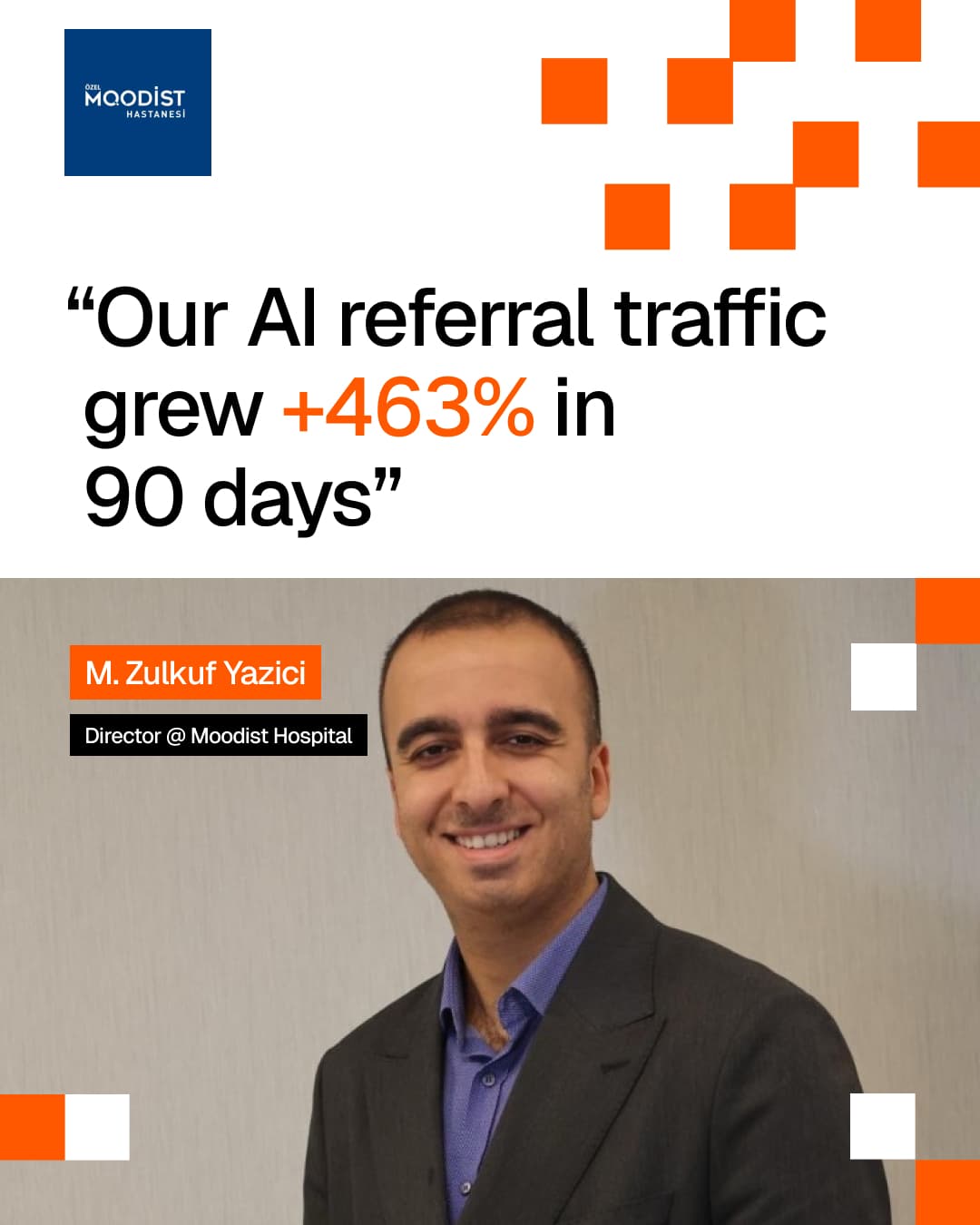
For a hospital, being invisible in those answers is the new "being on page two." Moodist Hospital decided to fix that — and in 90 days, the traffic arriving from AI assistants grew +463%.
Here's exactly what we did, and exactly how we measured it.
At a glance
| Metric | Result (90 days) |
|---|---|
| AI referral traffic | +463% |
| Intent-based prompts tested | 500+ |
| AI engines monitored | ChatGPT, Gemini, Perplexity, Google AI Overviews |
| Measurement cadence | Daily |
The challenge: a healthcare brand that AI didn't "know"
Moodist had a strong real-world reputation and a competent website. But when we ran the first baseline scan, the picture in the AI layer was very different from the picture in the real world:
- For most high-intent patient questions, the major assistants either didn't mention Moodist at all, or mentioned it without a link back to the site.
- Competitors — sometimes smaller, less specialized clinics — were being named first, simply because their content was structured in a way generative models could parse and cite.
- The brand had almost no citation footprint: the third-party pages AI models lean on (directories, editorial articles, Q&A pages) rarely referenced Moodist.
The core problem wasn't medical quality. It was machine-readability and citability. Generative engines answer from what they can confidently extract and attribute. Moodist's expertise existed; it just wasn't packaged in a form the models could surface.
Step 1 — We mapped the patient journey into 500+ intent-based prompts
The foundation of the whole project was not keywords — it was intents.
Traditional SEO starts with search volume. GEO starts with the questions a real person actually asks an assistant. So before optimizing anything, we built a prompt library of 500+ intent-based prompts that mirrored how prospective patients and their families actually talk to AI.
We organized them along the decision journey:
- Informational intent — "What are the symptoms of clinical depression?", "Is inpatient psychiatric treatment necessary for severe anxiety?"
- Comparative intent — "best private psychiatric hospitals in Istanbul", "Moodist vs other mental health clinics"
- Navigational / branded intent — "Moodist Hospital reviews", "does Moodist offer inpatient treatment?"
- High / transactional intent — "book a psychiatric consultation in Istanbul", "private rehab admission Turkey"
Each prompt was tagged by intent type, patient persona, language (TR/EN), and stage of the journey. This let us measure visibility where it actually converts — a brand can look fine on generic informational questions yet be completely absent on the high-intent ones that bring patients through the door.
Why 500+? Generative answers are non-deterministic. The same question can yield different brands on different days and across different models. A handful of prompts gives you anecdotes; a 500+ prompt panel gives you a statistically stable visibility signal you can trend over time.
Step 2 — We ran every prompt across every engine, daily
We executed the full prompt panel across the assistants patients actually use:
- ChatGPT
- Google Gemini
- Perplexity
- Google AI Overviews (the AI block above classic search)
Each run was scored on three things:
- Was the brand mentioned? (mention / no mention)
- Was it cited with a link? (the difference between "talked about" and "traffic-driving")
- How was it described? (sentiment & framing — critical in healthcare, where tone and trust matter)
Running this daily turned a noisy, one-off snapshot into a reliable baseline we could compare every optimization against.
Step 3 — We optimized for citability, not just ranking (GEO)
With the baseline in hand, the work split into two tracks.
A. Content & structure (on-site GEO):
- Rewrote and restructured key service pages so that the specific answer to a patient's question was extractable in a clean, self-contained passage — the format models prefer to quote.
- Added explicit, schema-backed answers to the highest-intent questions (services, conditions treated, admission process, location).
- Cleaned up the technical layer so AI crawlers could actually fetch and parse the content (we monitored crawler access directly, not just assumed it).
B. Authority & citations (off-site GEO):
- Identified the third-party sources the models were already citing for competing clinics, and worked to get Moodist accurately represented in those same trusted surfaces.
- Built and corrected the brand's presence on the directories and editorial pages that feed generative answers.
The goal of every change was a single question: "When the model answers this patient's question, can it confidently name Moodist and link to it?"
How we measured it — the metrics behind +463%
The headline number is AI referral traffic, but it sits on top of a measurement stack. Here's the full picture we tracked.
1. AI referral traffic (the outcome — +463%)
We isolated sessions whose referrer was an AI assistant (e.g. chatgpt.com, perplexity.ai, Gemini, and AI-Overview-attributed visits), separated from classic organic and direct traffic. This is the bottom-line metric: real people arriving on the site from an AI answer. Over the 90-day window it grew +463% versus the pre-engagement baseline.
2. Mention rate / Visibility Score (the leading indicator) The share of the 500+ prompts where Moodist appeared in the answer. This moves before traffic does — it's the early signal that the optimizations are landing.
3. Share of Voice (competitive position) Moodist's mentions vs. competitors' mentions for the same questions. Growth here means we weren't just more visible — we were winning the answer against other clinics.
4. Citation footprint (the traffic mechanism) How often, and from where, the models cited the brand with a link. Citations are the bridge between "mentioned" and "+463% traffic."
5. Sentiment (trust quality) In healthcare, how you're described matters as much as whether you're described. We tracked the tone of every AI mention to make sure rising visibility came with accurate, trustworthy framing.
Because all of these were measured daily on a fixed 500+ prompt panel, we could attribute movement to specific changes rather than guessing — and course-correct continuously instead of waiting 90 days to find out what worked.
The 90-day result
- +463% AI referral traffic — the core outcome, sustained, not a spike.
- A steadily climbing mention rate across all four engines, led by the high-intent comparative and branded prompts.
- A meaningful gain in share of voice against competing clinics on the questions that matter most to patient acquisition.
- A growing, accurate citation footprint that keeps compounding — each cited source continues to feed answers long after it's published.
What made it work — three takeaways for healthcare brands
- Optimize for intents, not keywords. Patients talk to AI in full, situational questions. A 500+ intent-based prompt panel is what turns "AI visibility" from a vibe into a measurable, trendable number.
- Visibility ≠ traffic. Citations are the bridge. Being mentioned is nice; being cited with a link is what moves referral traffic. We optimized specifically for citability.
- Measure daily, because generative answers change daily. A fixed panel run every day is the only way to separate real progress from the natural day-to-day noise of LLM outputs.
The bottom line
AI assistants are becoming the first place patients ask about their care. The hospitals that show up — accurately, trustworthily, and with a link — will own that moment. Moodist Hospital decided to be one of them, and in 90 days turned near-invisibility into a +463% lift in AI referral traffic.
Methodology note: AI referral traffic is measured from sessions attributed to AI-assistant referrers and AI-Overview-attributed visits, compared against the pre-engagement baseline. Visibility, share-of-voice, citation, and sentiment metrics are computed daily across a fixed panel of 500+ intent-based prompts run on ChatGPT, Gemini, Perplexity, and Google AI Overviews.