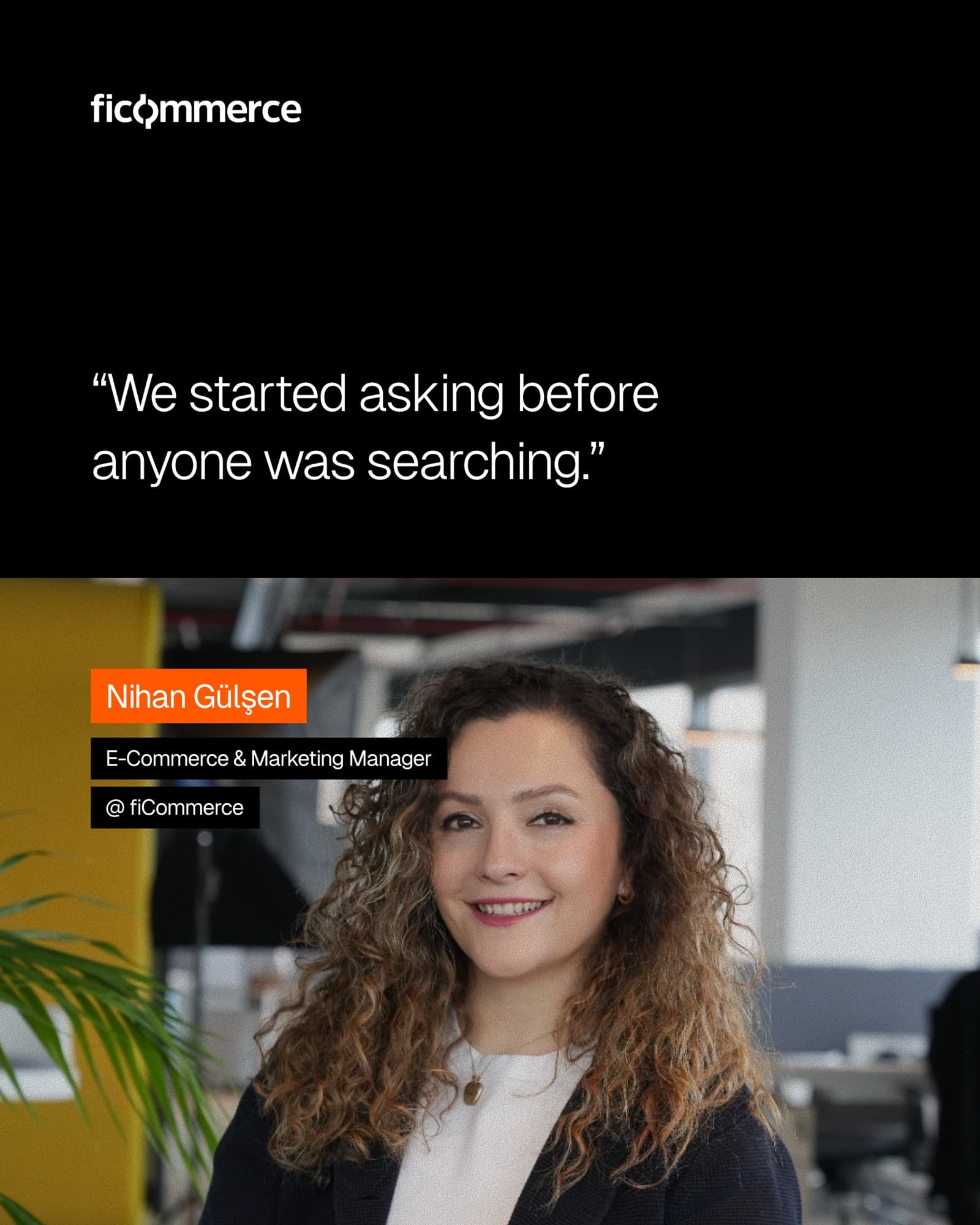
Customer story · E-commerce
We started asking before anyone was searching.
How fiCommerce built an AI visibility routine before the category had a name — and stayed ahead of it.
At a glance
- Company
- fiCommerce
- Industry
- E-commerce
- Using Maya since
- Among the first cohort
- Favourite features
- Prompt suggestions · AI search volumes · Content support
The challenge
The question nobody was asking yet
Every e-commerce team knows how to check where they rank on Google. Almost none of them knew — or could know — where they stood when a customer skipped the search box entirely and asked an assistant instead.
fiCommerce saw the shift before it showed up in anyone's reporting. Customers were starting to ask AI assistants what to buy, which brand to trust, which platform to build on. Those conversations produced no impressions, no click data, no rank position. They were invisible by default.
The team's problem wasn't that visibility had dropped. It was that a whole new surface had appeared and nobody had a way to measure it.
That's a hard problem to act on, because it fails silently. You don't lose traffic you never knew existed.
Why Maya
From a blind spot to a routine
fiCommerce started using Maya when AI visibility was still an emerging idea rather than an established practice. What they needed first wasn't a dashboard — it was a way to turn an abstract worry into something they could check on a Monday morning.
Three parts of the product carry that routine.
Feature 1 — Prompt suggestions
Knowing which questions are worth tracking
The hardest part of AI visibility isn't monitoring. It's knowing what to monitor.
A brand can track fifty prompts and learn nothing, because it invented all fifty in a meeting room. Real customer questions rarely sound like internal category language — they're longer, messier, and framed around a problem rather than a product.
Maya's prompt suggestions close that gap. Instead of guessing how customers phrase things, fiCommerce works from a generated set grounded in their category, competitors and market, then curates it down to what matters.
→ The tracked set reflects how people actually ask, not how the brand talks about itself.
You can't improve your position in a question you never thought to ask.
Feature 2 — AI search volumes
Separating real demand from internal assumption
Not every prompt deserves attention. Some questions get asked constantly; others sound important internally and are asked by almost no one.
AI search volumes give fiCommerce the weighting layer. A prompt where the brand is invisible matters enormously if it carries real demand — and barely at all if it doesn't. That single distinction is what turns a list of gaps into a prioritised plan.
→ Effort goes where the demand is, and the team can defend that choice with data rather than instinct.
Feature 3 — Content support
Closing the gap between knowing and doing
Most AI visibility tools stop at diagnosis. They tell a brand it isn't cited and leave the hard part — what to actually publish — to the team.
Maya's content support carries the finding through to the work: what to write, how to structure it, which gaps in the existing content are keeping the brand out of the answer. For fiCommerce, this is the step that converts a report into a result.
→ Findings become published pages, and published pages move the number.
Telling a brand it's invisible is easy. Telling it what to publish is what moves the number.
The part they mention most
Not a feature — a tempo
Ask fiCommerce what they value about Maya and the answer isn't on the feature list.
“What I love most about Maya is how quickly updates are rolled out. They keep up with all the latest developments in AI and adapt to them immediately. That's why seeing a new feature in Maya is just a matter of time.”
For us, that's less a compliment than a job description.
AI visibility is a field where the rules change monthly. Models get replaced. Answer formats change shape. The way sources get selected and cited shifts without announcement. A tool that ships twice a year in this category isn't stable — it's out of date, quietly, between releases.
fiCommerce understood that early. Running at that speed is something we learned from customers like them.
Results
What changed
fiCommerce moved from no AI visibility measurement at all to a weekly operating routine:
- A tracked prompt set that is curated rather than guessed — grounded in how customers actually ask.
- Prioritisation driven by measured demand instead of internal assumption.
- Content decisions that now start from a gap in the answer, not a hunch in a meeting.
Closing
Early isn't a personality trait. It's a measurement decision.
fiCommerce didn't get ahead of AI search because they predicted the future. They got ahead because they started measuring a surface while it was still forming — and kept measuring it as it changed.
That's the whole advantage, and it's still available. The brands showing up in AI answers today are mostly the ones who started asking earlier.
See where your brand shows up in AI answers
Frequently asked
What does fiCommerce use Maya for?
fiCommerce uses Maya to track how its brand appears in AI assistant answers, using prompt suggestions to identify which customer questions to monitor, AI search volumes to prioritise them, and content support to act on the gaps.
What is AI visibility?
AI visibility measures whether and how a brand appears in answers generated by AI assistants such as ChatGPT, Gemini, Perplexity and Claude — a surface that traditional search rankings and analytics do not capture.
Why does update speed matter in AI visibility tools?
Because the underlying models, answer formats and citation behaviour change frequently. Tools that update infrequently reflect an outdated version of how AI assistants select and cite sources.