Most brands come to AI visibility with the same goal: "we already sell this — make sure the assistants recommend us instead of our competitors."
MağazanOlsun had a harder, more interesting problem. They didn't just want a bigger slice of an existing category — they were launching a new one. A new e-commerce model that shoppers hadn't searched for yet, because they didn't know it existed.
That changes everything about how you get discovered. And it's exactly the moment AI search is built for. Working with Maya, MağazanOlsun grew its AI referral sessions roughly 15× and lifted AI referral traffic by more than 500% — a channel that barely existed before.
At a glance
| Metric | Result |
|---|---|
| AI referral sessions | ~15× |
| AI referral traffic | +500% |
| AI engines monitored | ChatGPT, Gemini, Perplexity, Google AI Overviews |
| The unlock | A new acquisition channel for a brand-new category |
The challenge: you can't rank for a category nobody searches for yet
Classic search rewards demand that already exists. Someone types "running shoes," and the pages competing for that phrase fight it out. But when you introduce something genuinely new, there's a gap:
- No search volume yet. Nobody types the exact keyword for a model they've never heard of — so traditional SEO has almost nothing to rank for.
- The value has to be explained, not just listed. A new category needs the shopper to first understand the problem it solves, then connect it to the product.
- Awareness is the real bottleneck. The product was ready. The question was: how do thousands of potential shoppers find out it exists in the first place?
This is where AI assistants behave differently from a search box. People don't just search AI for brand names — they describe a situation ("I want to open my own store but…", "what's the easiest way to start selling online?") and ask the assistant to recommend a solution. If your new model is the answer to that situation, AI can introduce you to demand that keyword search simply can't reach.
MağazanOlsun's insight was to treat AI search not as a defensive SEO problem, but as the discovery channel for a new category.
Step 1 — We mapped the situations, not the keywords
Because there was no established keyword to chase, we started from the shopper's problem. With Maya we built a prompt library around the real, situational questions people ask an assistant when they're in MağazanOlsun's territory — organized by intent:
- Problem intent — the situations the new model solves, phrased the way a real person would describe them to ChatGPT.
- Comparison intent — "best way to…", "alternatives to…", "which is easier…" — the questions where a new option can be surfaced next to the familiar ones.
- Discovery intent — open-ended "how do I…" and "what should I use to…" prompts, where assistants are most willing to recommend something the user hadn't considered.
- Branded intent — direct "what is MağazanOlsun / is it any good" questions, to make sure that once curiosity is sparked, the answer is accurate and trustworthy.
Each prompt was tagged by intent and buyer situation, so we could measure visibility where it actually creates awareness — not just on generic terms.
Why start from situations? For a new category, the win isn't "rank #1 for a keyword." It's being named as the answer the moment a shopper describes the problem you solve. Situational prompts are how you measure that.
Step 2 — We ran every prompt across every assistant, and tracked it over time
We executed the prompt panel across the assistants shoppers actually use:
- ChatGPT
- Google Gemini
- Perplexity
- Google AI Overviews (the AI block above classic search)
Every run was scored on the three things that matter:
- Was MağazanOlsun mentioned? (are we in the answer at all?)
- Was it cited with a link? (the difference between being talked about and driving an actual visit)
- How was it described? (is the new model explained accurately and appealingly?)
Tracking this continuously turned a one-off snapshot into a trendable signal — so we could see the new category go from invisible to recommended, and tie that movement to specific work.
Step 3 — We made the new model explainable and citable (GEO)
For a new category, the whole game is making sure the assistant can confidently explain what you are and why you're the answer. With Maya's guidance, the work ran on two tracks:
A. On-site — teach the model the category.
- Structured the site so the problem → solution → how it works story sits in clean, self-contained passages an LLM can quote directly.
- Answered the highest-intent situational questions explicitly, in the shopper's own language, so the model has a ready-made, accurate answer to lift.
- Kept the technical layer clean so AI crawlers could actually fetch and parse the content.
B. Off-site — build the citation footprint.
- Identified the third-party surfaces assistants lean on when they recommend solutions in this space, and worked to get MağazanOlsun accurately represented there.
- Turned scattered mentions into a growing set of citable, linkable references that keep feeding answers over time.
The single test for every change: "When a shopper describes this situation, can the assistant name MağazanOlsun, explain the new model correctly, and link to it?"
The result: a new channel, and discovery beyond expectations
As the optimizations landed, the assistants started doing what a new category needs most — introducing MağazanOlsun to shoppers who were describing the problem but had never heard of the solution.
- AI referral sessions grew roughly 15× — real people arriving on the site from an AI answer, in a channel that was previously negligible.
- AI referral traffic climbed more than 500%, sustained rather than a one-off spike.
- AI search became a genuinely new acquisition channel — demand arriving from ChatGPT, Gemini, Perplexity and AI Overviews, not from a keyword MağazanOlsun had to invent from scratch.
- The discovery ran well beyond expectations — precisely because AI reaches demand that classic search, with no existing keyword, structurally could not.
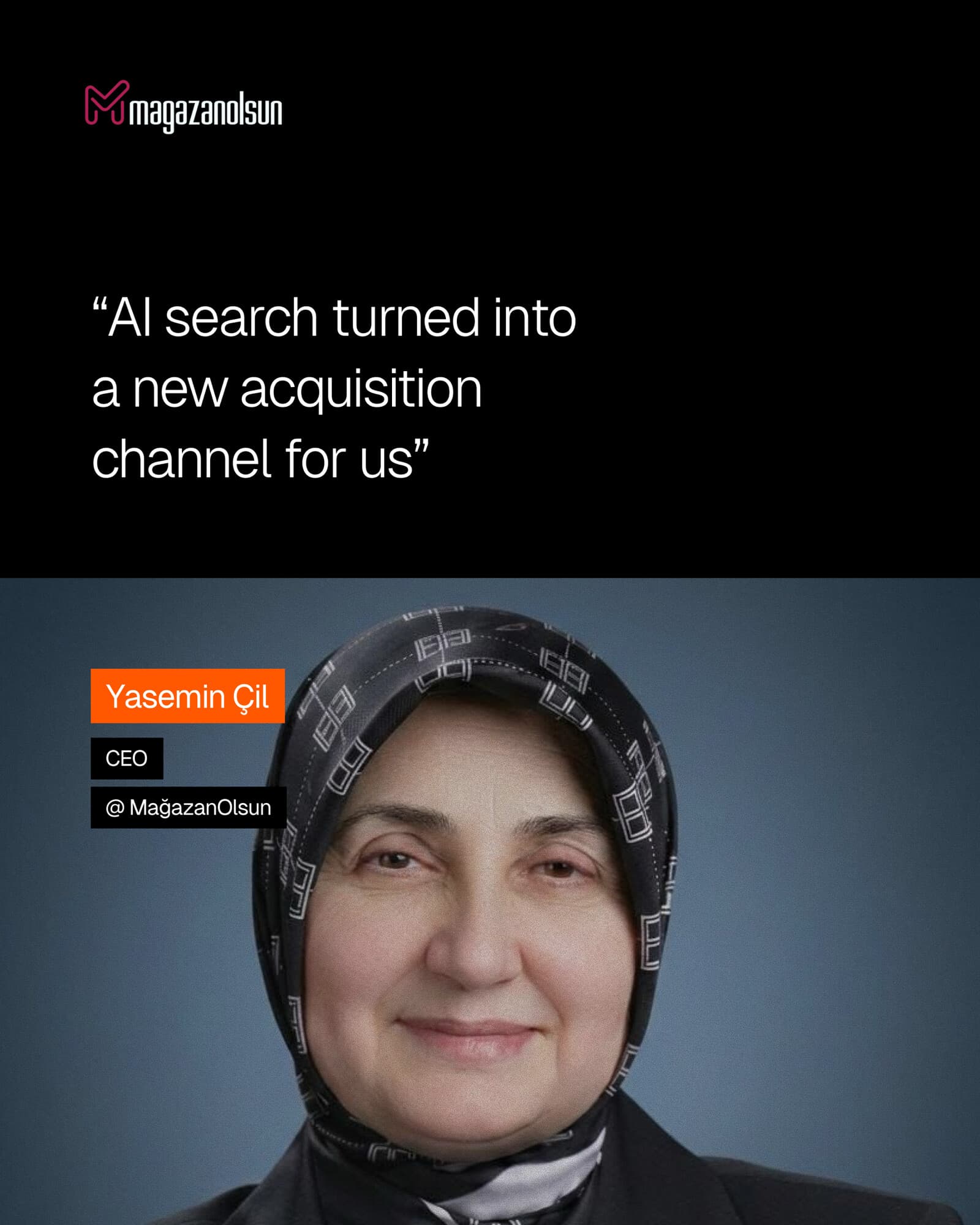
As CEO Yasemin Çil put it: "AI search turned into a new acquisition channel for us."
What made it work — three takeaways for anyone launching something new
- New category? Start from situations, not keywords. You can't rank for demand that doesn't exist yet — but you can be the answer the assistant recommends when a shopper describes the problem.
- AI reaches demand that search can't. Assistants recommend solutions to situations, which is exactly how a new offering gets in front of people who didn't know to look for it.
- Being explainable beats being optimized. For a new model, the win is the assistant understanding and accurately describing what you are — then citing you with a link. Optimize for citability.
The bottom line
When you create something new, your hardest job isn't beating competitors — it's being discovered by people who don't yet know your category exists. MağazanOlsun used Maya to make its new e-commerce model discoverable inside the AI assistants shoppers now ask first — growing AI referral sessions ~15×, lifting AI referral traffic 500%+, and turning AI search into a brand-new acquisition channel, beyond expectations.
Methodology note: Visibility, share-of-voice, citation and sentiment metrics are computed continuously across a fixed panel of intent-based prompts run on ChatGPT, Gemini, Perplexity and Google AI Overviews. AI-sourced traffic is measured from sessions attributed to AI-assistant referrers and AI-Overview-attributed visits.