We Analyzed 30 Million ChatGPT Citations: Brand-Owned Sites Lost 26% of Their Share
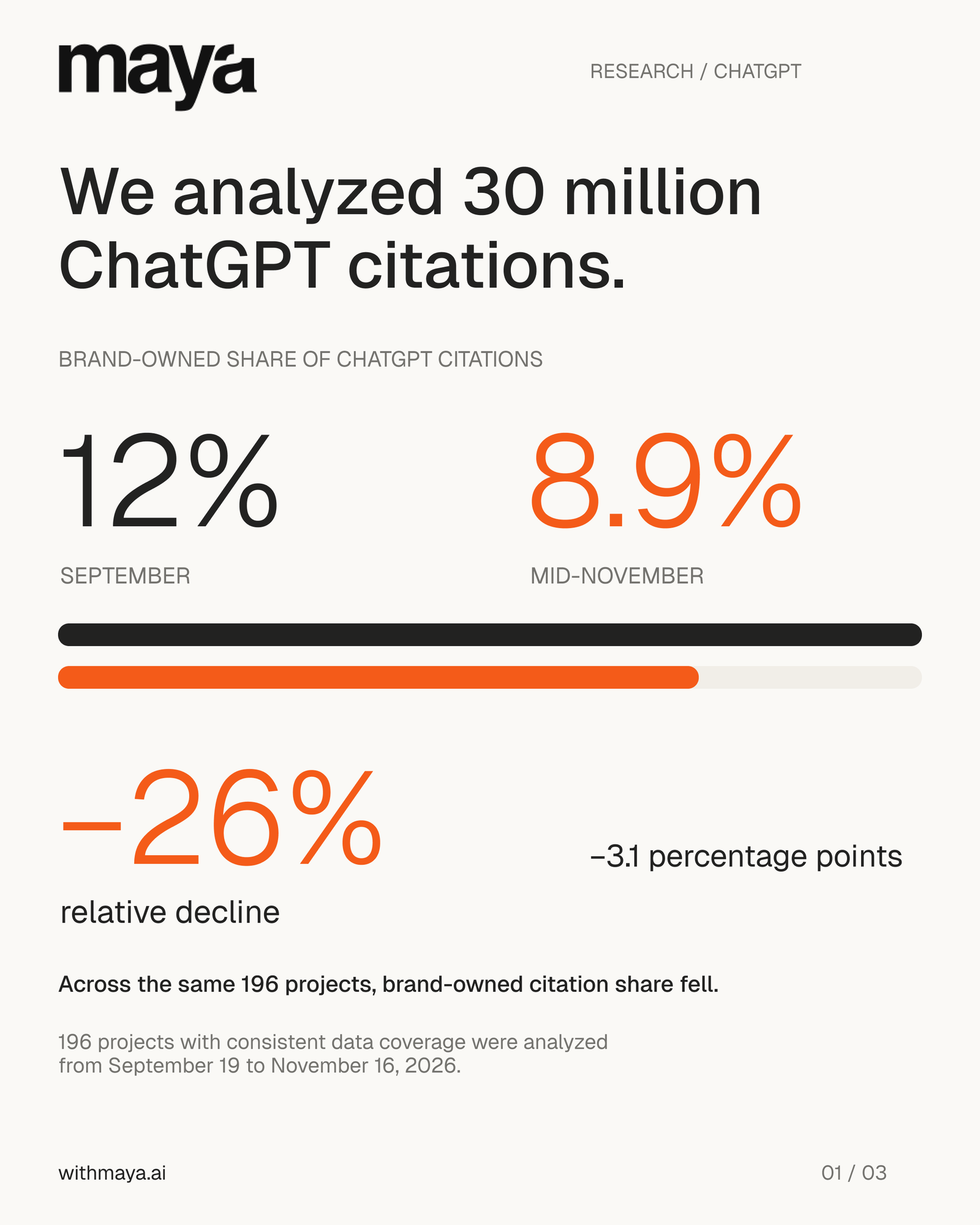
Across the same 196 projects, the share of ChatGPT citations going to a brand's own website fell from 12% in September to 8.9% by mid-November 2026. Here is what the data shows, what it does not, and what to do about it.

Prefer Maya AI in Google
Highlight our stories in Search, AI Mode & AI Overviews.
Languages / Diller: English (this page) · Türkçe
Last checked: November 17, 2026
When ChatGPT answers a question about a brand or its category, it cites sources. Some of those sources are the brand's own website. Most are not. We looked at how that split changed over two months, using 30 million ChatGPT citations collected in Maya.
The short answer
Across the same 196 projects, the brand's own website accounted for 12% of ChatGPT citations in September 2026 and 8.9% by mid-November 2026. That is a drop of 3.1 percentage points, or about 26% in relative terms.
| Measure | September 2026 | Mid-November 2026 | Change |
|---|---|---|---|
| Brand-owned share of ChatGPT citations | 12% | 8.9% | −3.1 percentage points (−26% relative) |
| Citations to brand-owned sites, per answer | ~1.45 | 1.05–1.1 | lower |
| Citations to other sites, per answer | ~13 | ~14 | slightly higher |
The first row covers the fixed group of 196 projects. The two per-answer rows cover all projects and compare September 19–29 with November 9–16.
What "brand-owned citation share" means
For each project, Maya collects ChatGPT's answers to a set of tracked questions and records every source the answer cites.
Brand-owned citation share = citations pointing to the brand's own website ÷ all citations.
A share of 12% means that out of every 100 sources ChatGPT cited in those answers, 12 were pages on the brand's own site. The other 88 were news sites, marketplaces, review platforms, forums, competitors and everything else.
How we measured it
- Period: September 19 to November 16, 2026.
- Engine: ChatGPT only.
- Volume: about 30 million citations in total.
- Fixed group: 196 projects that had consistent data coverage through the whole period. Using the same projects at both ends matters, because a share can move simply because the set of brands being measured changed. The 12% → 8.9% figure comes from this group.
- Per-answer figures: calculated across all projects, using only answers that cited at least one source.
The decline started before the share fell
The headline number is a before-and-after comparison. The path between the two points was not a straight line.
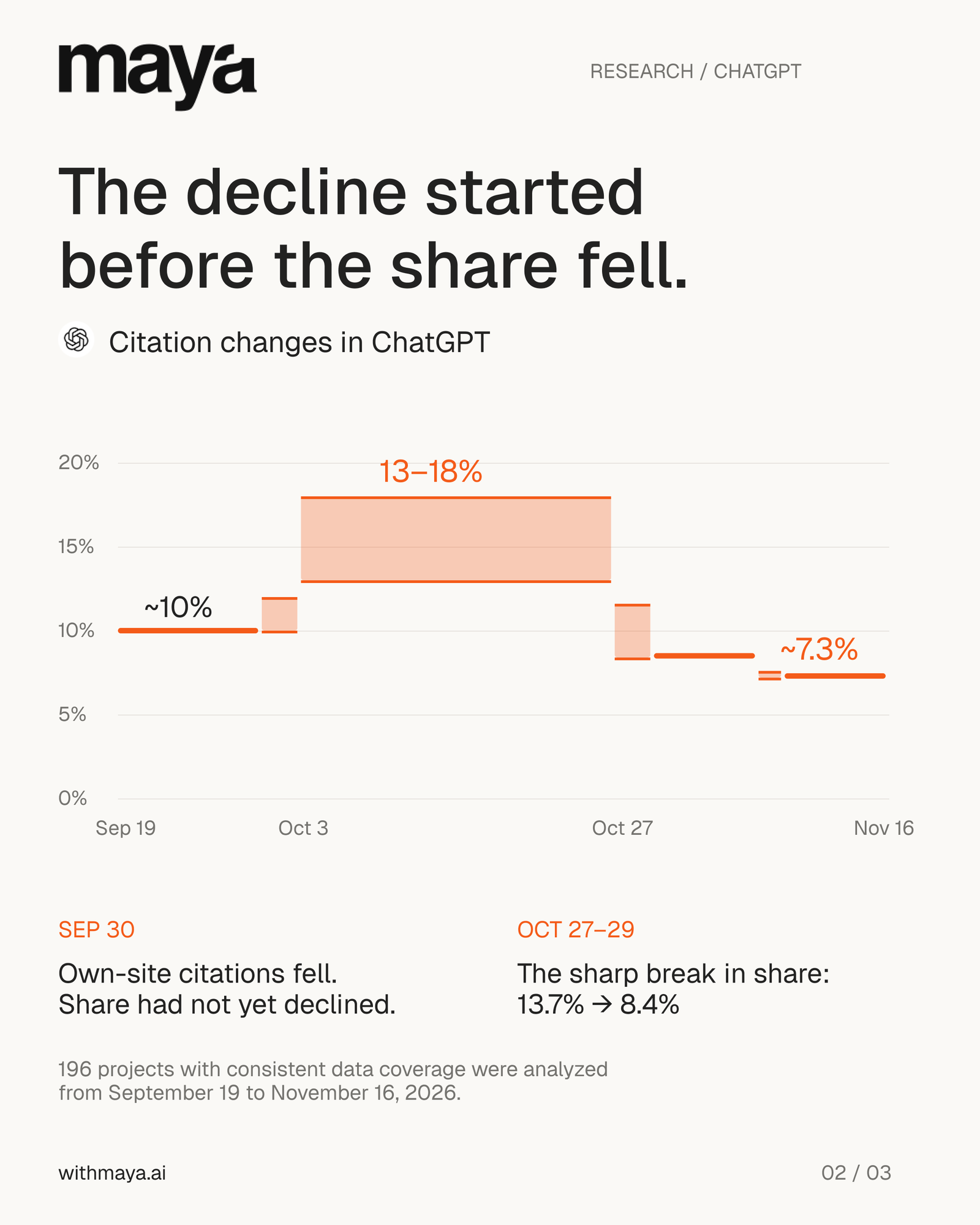
Across all projects, brand-owned share sat around 10% in the second half of September. Two dates stand out after that:
- September 30. The number of citations going to brand-owned sites fell. The share did not fall with it. Through most of October it was actually higher, in a band between 13% and 18%.
- October 27–29. The share broke sharply, from 13.7% to 8.4% in three days. By mid-November it was around 7.3%.
So there were two separate events: first fewer own-site citations, and about four weeks later a drop in share. The bands on the chart show the range reported for each stretch of the period. They are not a daily series.
Other sources recovered. Brand sites did not.
The per-answer figures explain why the share moved the way it did.
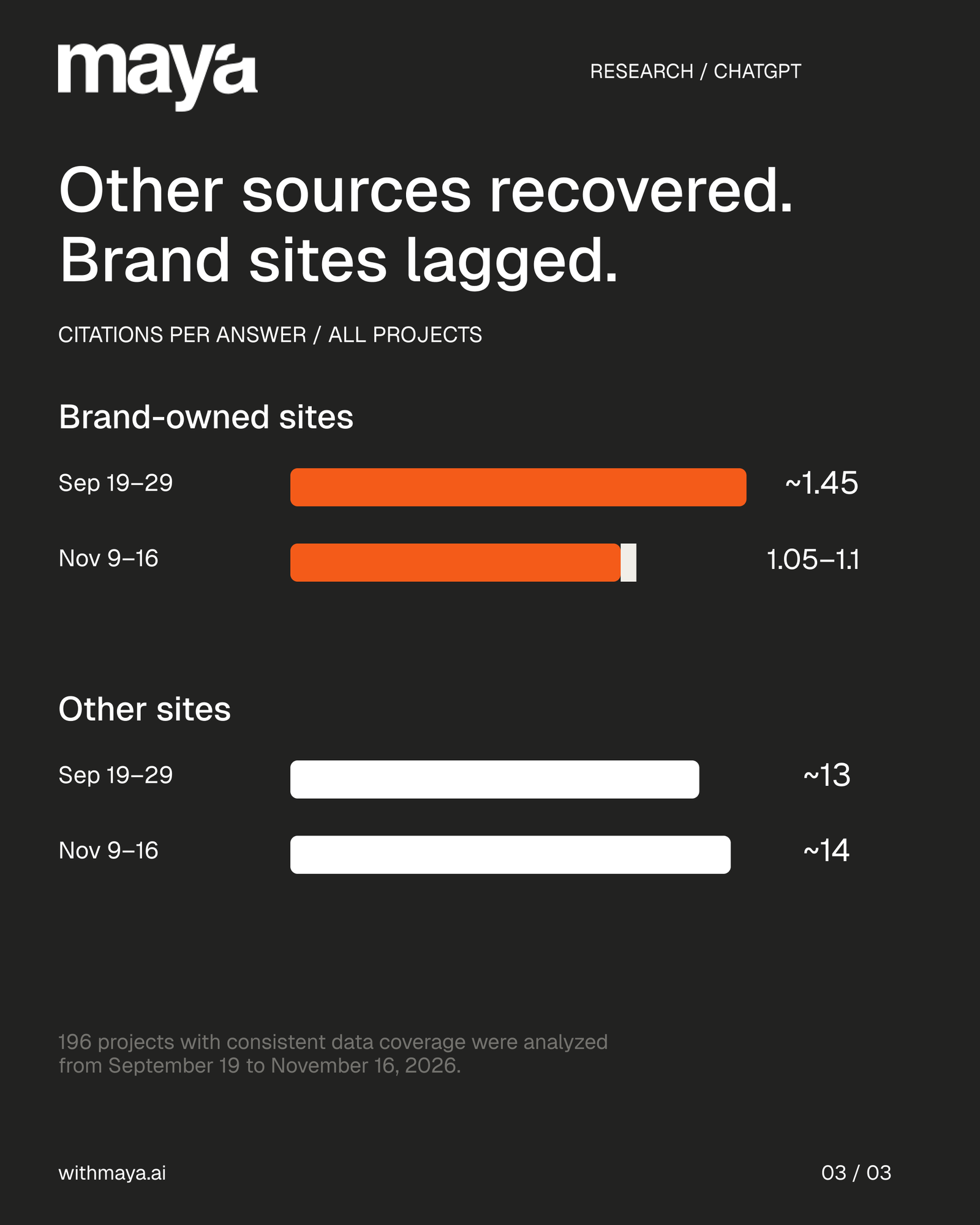
- Brand-owned sites: about 1.45 citations per answer on September 19–29, and 1.05–1.1 on November 9–16.
- Other sites: about 13 citations per answer on September 19–29, and about 14 on November 9–16.
By mid-November, ChatGPT was citing other sites slightly more often than in September, and brand sites noticeably less. A share is a ratio, so both sides of it matter: fewer own-site citations on top, and a recovered count of other-site citations underneath.
This is also why share alone can mislead. In October the share was at its highest point of the period while own-site citations per answer were already down. If you only watched the percentage, October looked like a good month.
What this data does not show
- It does not show the cause. We can see when the numbers moved. We have not confirmed whether the breaks come from a change in how ChatGPT selects sources.
- It is not a statement about every brand. These are aggregate figures. Individual brands in the group moved in both directions.
- It is ChatGPT only. Other engines were not part of this analysis.
- Fewer citations to your site is not the same as fewer mentions of your brand. An answer can recommend a brand while citing a third-party page about it. Citation share measures where the sourcing comes from, not whether the brand appears.
What this means for your brand
1. Track the count, not only the share. Follow own-site citations per answer next to the percentage. The count tells you whether ChatGPT is using your pages. The share also moves when other sites gain or lose citations.
2. Compare like with like. Use the same set of questions when you compare two periods. Adding or removing questions changes the share on its own.
3. Look at who is cited instead. At roughly 1 own-site citation and 14 other-site citations per answer, most of what ChatGPT reads about your category is written by someone else. List the third-party pages cited for your most important questions and check what they say about you. We covered why this happens in Why AI Answers Cite Reddit and Review Sites Instead of Your Website.
4. Fix the facts where they are cited. If a cited comparison page, marketplace listing or review has outdated prices, features or availability, that is the version of your brand ChatGPT repeats. Correcting those sources is often faster than publishing a new page of your own.
5. Keep your own pages citable. Own-site citations fell; they did not disappear. Pages that state a specific fact clearly, such as a price, a specification, a policy or a definition, are still the ones an engine can cite for that fact.
6. Mark the dates. If your own citation numbers moved around September 30 or October 27–29, check that against this pattern before you attribute the change to something you did on your site.
See it for your own brand
In Maya, the Citations page shows your own-site share, the count behind it and the third-party sites cited for each question you track. If you would like to go through your numbers together, write to us at [email protected].

GEO researcher at Maya. Studies how large language models retrieve, rank, and cite sources — and what brands can do to show up in AI answers.